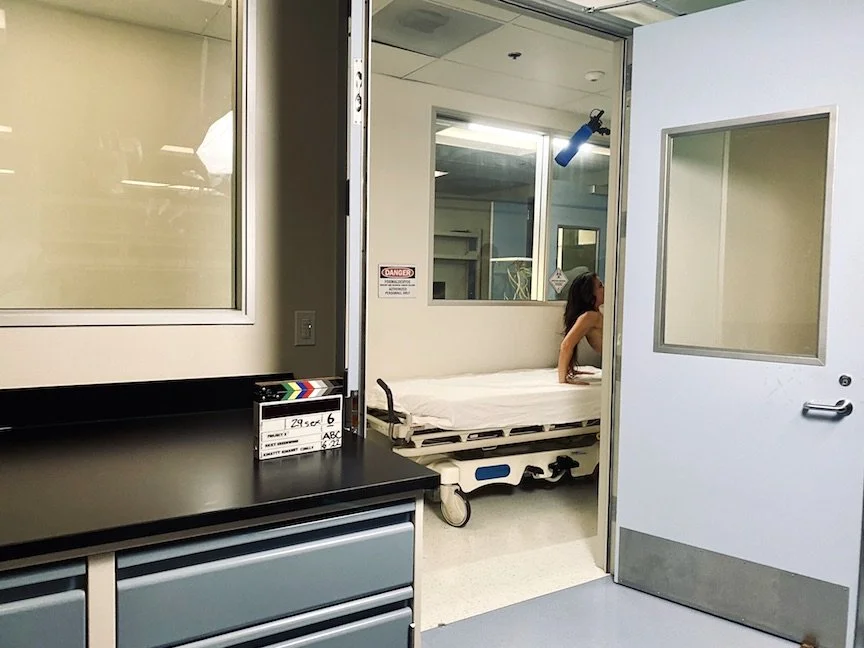
Adult movie set, Monrovia, Calif., 2024 | Photo credit: Susannah Breslin
PORN BLIND
Words and photos by Susannah Breslin
I spent almost 30 years writing about the adult movie business. Along the way, I learned a lot about porn—and myself.
I
Late in the afternoon of July 13, 2024, I received a phone call from an investigative journalist friend of mine who had heard that a mutual friend of ours, the investigative journalist Evan Wright, had died. Because my friend received this information secondhand, I wasn’t sure what to think. I asked if he had checked the website of the County of Los Angeles Medical Examiner. On the other end of the line, my friend searched the site’s case records. That confirmed it. The manner of death was suicide, and the cause was a gunshot wound to the head. Evan was 59.
I had met Evan over two decades earlier, not long after I moved from the San Francisco Bay Area, where I was born and raised, to Los Angeles. In the late Nineties, a group of us journalists formed an informal collective that met irregularly at Los Angeles bars in a social gathering we named The Hacks Lounge. One night, Evan showed up. He was tall, like me, armed with a bristling intensity and a penetrating blue-eyed gaze, and peppered his speech with sarcastic, self-deprecating comments. In a few years, he would propel himself into the journalistic stratosphere, embedding with the 1st Reconnaissance Battalion of the United States Marine Corps during the 2003 Invasion of Iraq, a harrowing journey he recounted in a three-part series for Rolling Stone, which won a National Magazine Award. After that, he developed his reporting into a much-lauded book, Generation Kill, which was turned into an acclaimed HBO miniseries adapted by The Wire creator David Simon.
As we stood near the bar, Evan and I discovered we had something else in common: a fascination with the San Fernando Valley’s adult movie business. A freelance journalist, I had written a few stories about the porn industry. Evan had been the entertainment editor and “chief pornographic film reviewer” for Hustler magazine. (In “Scenes from My Life in Porn,” a darkly confessional LA Weekly cover story, published in 2000, in which he chronicles his descent into the bowels of porn during his Hustler tenure, he writes: “Larry Flynt used to defend Hustler by calling the nude photo layouts ‘art.’ I would come to joke that the porn video is indigenous Southern California folk art.”) By that point, we had both spent a fair amount of time on porn sets. Through our shared interest in that strange, subterranean world we formed a unique bond.
The next time I saw Evan, it was spring. The setting was a cavernous, concrete-floored soundstage in Canoga Park, a suburban neighborhood on the west side of the Valley. The occasion was the filming of The World’s Biggest Gang Bang III, the latest installment in a series of porn movies in which adult actresses attempted to break the world record for having sex with the most men in a day. The production was part of a broader adult movie trend towards the extreme at the turn of the millennium commonly referred to as “stunt sex.” By the early aughts, the affordability of home video cameras, the wide scale availability of adult content through personal computers, and a mostly hands-off approach to obscenity prosecutions by President Clinton led to increased competition in the porn business. With in excess of 10,000 explicit films released every year, a competitive frenzy among producers took hold, pushing pornographic content to the outer reaches of the sexual frontier.
The star of the movie was Houston, a blonde, surgically enhanced, strategically minded adult actress who intended to launch herself into greater fame and increased riches with this beyond-the-pale erotic performance. In homage to the Indianapolis 500, the set was decorated in a race car theme, including checkered flag banners and a towering trophy. (The press release asserted Houston had sex with over 500 men that day; the actual number was closer to 120, by my estimation.) At center stage was a human-sized lazy Susan upon which she would perform.
When I arrived, the line of men who came from parts unknown for the opportunity to get to know a porn star on a more intimate level snaked out the door and across the parking lot. Inside, the aspirants who passed muster milled about, waiting for something to happen. They wore white T-shirts commemorating the ignominious event and numbered race bibs of the sort worn by marathon runners but no pants.
Before long, the stage was teeming with people: twenty or so ringers (male porn stars hired by the production company to ensure at least a modicum of successful performances) and their amateur counterparts who had been relegated to the grandstands; a roving band of fluffers (lower-tier porn stars paid to provide assistance to any participants who needed help meeting the moment); random lookie-loos (Larry Flynt’s brother Jimmy, Moonlite Bunny Ranch brothel owner Dennis Hof, and Joey Buttafuoco among them); a phalanx of national and international press; and crewmembers working desperately to contain the congregants.
Finally, Houston drove onto the set in a real race car. She exited the vehicle to scattered applause and assorted whoops.
“Let’s get started,” someone announced.
As the cameras rolled, Houston stripped off her red Lycra bodysuit and climbed onto the lazy Susan.
“Action!” the director shouted.
As I scanned the crowd, I spotted Evan standing on the sidelines. His eyes were wide, and his mouth was agape. Like me, he had been unable to resist the siren’s call of this orgasmic display. Between us, Houston was laboring on all fours, bookended by two men—one in front of her and one behind her—and they high-fived over her body as we looked on. When Evan noticed me staring at him, he smiled like the Cheshire cat.
I know what he was thinking: We’re two of a kind.
Three years earlier, just before midnight, on January 6, 1996, I was awakened by a phone call. It was my stepmother. My father, who was 60, had a heart attack. Now, he was dead. The first responders had been there and left already. Soon, someone from the cremation service would arrive to take him away.
You should come and see him, she told me.
In my dimly-lit studio apartment, I sat down on the edge of my bed. The room seemed to be spinning, so I closed my eyes. In their living room, my father’s six-foot-four dead body was lying on their pale pink living room carpet. He wouldn’t have wanted me to see him like that.
I don’t think so, I replied.
At 27, I was still trying to figure out what to do with my life. I wanted to be a writer, but I was afraid I would fail at it. Both my parents were English professors—my father at the University of California, Berkeley and my mother at Saint Mary’s College, a private college in the East Bay. My father was the author of three books: William Carlos Williams: An American Artist; From Modern to Contemporary: American Poetry, 1945–1965; and Mark Rothko: A Biography, which Hilton Kramer, writing in The New York Times Book Review, proclaimed “the best life of an American painter that has yet been written […] a biographical classic.” My father was the writer, not me.
In the clearest childhood memory I have of my father, he has ensconced himself in the second-floor enclosed porch off my parents’ bedroom that we referred to as “the study.” On the other side of the French doors, he is sitting at a gunmetal grey metal typewriter table. Click-clack-click, the manual typewriter says, as he pokes the keys with his index fingers. His back to me, he hunches forward, focused on the important task before him. I am not to disturb him, but I linger anyway, yearning for his attention. My forehead is pressed against the cool glass of the windowpane. I want to be him. I resent him. I love him. I hate him.
When my father left my mother, I was 10. On the day he moved out, I returned to our pink stucco home on a steep single-block street in the lower tiers of the Berkeley Hills from the private grade school I attended in the Flats alongside kids whose hippie parents thought it was a good idea to give their children names like Sunshine and Storm to discover empty spaces in the living room built-in bookshelves where his books had been.
After their divorce, my Mount Holyoke College-educated, devoutly feminist mother, who sacrificed her writerly aspirations to support her husband’s professional ambitions and raise my older sister and me, retreated into a deep depression from which she never emerged.
I don’t want to be a mother anymore, she took to saying.
By the time my father died, I had earned a bachelor’s degree in English from U.C. Berkeley and a master’s degree in English from the University of Illinois Chicago’s Program for Writers. After graduate school, I had moved back to the Bay Area, where I rented a gloomy third-floor unit in a Tudor-style building near Oakland’s Lake Merritt and taught English composition to uninterested community college students.
In the wake of his death, I was unmoored. I experiencing panic attacks and overwhelming depressions. Worried I would throw myself out my apartment window, I slept on a pile of dirty clothes in my walk-in closet. Unable to foresee the person I might become without my father’s long shadow looming over me, I imagined committing suicide in the same manner as his longtime biographical subject—Rothko, who, at 66, had ingested a large amount of barbiturates and slashed his arms just below the crooks of his elbows with a double-edged razor blade.
As the days, and weeks, and months passed, I didn’t kill myself. Instead, I took small steps towards becoming a writer in my own right. One of my short stories was published in an anthology of “postfeminist fiction.” Two of my girlfriends from graduate school and I launched an online literary magazine, The Postfeminst Playground. I wrote book reviews for Bay Area weeklies. I sold an article to a glossy men’s magazine.
One afternoon, I was flipping through a weekly when an ad caught my eye. An up-and-coming porn star named Jenna Jameson was coming to town. That weekend, she and another porn star, Jill Kelly, would be performing at the Mitchell Brothers O’Farrell Theatre in San Francisco. Apparently, Hunter S. Thompson, one of my literary heroes and the O’Farrell’s former night manager, had described the theater as “the Carnegie Hall of public sex in America.” I pitched the story to my editor at the men’s magazine and landed an assignment.
That Friday night, I watched as Jameson and Kelly stomped across the stage in silver bikini-style costumes and thigh-high platform boots like oversexed stormtroopers. Marilyn Manson wailed from the speakers about the beautiful people as the duo stripped off their clothes, exposing gravity-defying breasts with half-moon surgical scars below them. For the grand finale, Kelly did a handstand while Jameson simulated oral sex on her. In the audience, the slack-faced men gawked at the spectacle as if bearing witness to the Rapture—gobsmacked.
After the show, the women posed with fans for $20-a-pop Polaroids. In booths, nude women lounged on tabletops, penetrating themselves with dildos, surrounded by men acting as if they were attending a particularly fascinating fondue party. Other men disappeared into red velvet-lined rooms hidden behind shimmering gold curtains, led by scantily clad, beglittered women who smelled of peaches and apricots.
In the early morning hours, Jameson and Kelly were greeted in front of the theater by two smiling Japanese businessmen. I loitered at the curb as the foursome slipped into the dark bowels of a black stretch limousine waiting outside and headed for parts unknown.
A year and half after my father died, I found myself on the set of a porn movie for the first time. The movie’s title was Flashpoint, which was fitting; according to Merriam-Webster, flash point is “a point at which someone or something bursts suddenly into action or being.” Jameson’s publicist had told me were I ever in Los Angeles, I was welcome to visit a set. Not long after I went to the O’Farrell, I took her up on her offer.
Flashpoint concerns itself with the devastating fallout of a fiery tragedy. “After Doug, a member of the Fire Station #23 gets killed in a car explosion, the rest of the team is left with some pretty heavy issues to handle,” the marketing copy reads. “Some wonder why they ever got involved in firefighting, others just try to deal with the pain and anger of such a loss while continuing to save lives.” Instead of exploring their grief with a therapist or sharing their feelings in a support group, these firefighters seek to manage their sadness by having sex.
In a parking lot near downtown Los Angeles, I mingled with the other journalists, all of whom were middle-aged men who wrote for magazines like Oui and Cheri. Until then, my training as a reporter was limited to an undergraduate journalism class from which I recalled two things: a story was supposed to be shaped like an inverted pyramid and most journalists didn’t make a lot of money.
Here, none of that mattered. Twenty feet away, seven actors—four men and three women—were having sex on and around a firetruck. A camera on a crane swooped over the action like a hunting hawk. The crewmembers observed with glazed-over eyes while the Los Angeles Fire Department firefighters who had delivered the firetruck that was rented from the city beheld the activities with awestruck expressions. Every so often, the director barked out new instructions, and the naked bodies reconfigured into different positions. I took illegible notes in my Reporter’s Notebook.
An hour passed. Positions changed. A dog barked. A plane flew across the sky. Somebody yawned. A woman moaned. Inner thighs trembled. Missionary became doggie. Woman-on-top became man-on-top. The three-way deconstructed and reassembled. The blonde on the ladder had an orgasm, her high-pitched cry warbling through the industrial area.
Suddenly, one of the three-way’s woodsmen stepped backwards, moving away from the woman bent over in front of him, with whom he had been having sex. He was staring at his flaccid member in his hand as if it belonged to someone else. The tension was palpable.
“Lube!” the woodsman yelled like a desperate soldier calling for a battlefield medic. A small bottle sailed through the air and landed in his upraised palm with a smack! Within minutes, he had resumed his mechanical plowing. Disaster had been averted.
Two hours after filming began, it was time for the men to deliver their money shots.
A few feet away, crewmembers discussed a “FIP.”
“What’s a FIP?” I whispered to the nearest porn writer.
“A fake internal pop” was the answer.
As the camera levitated before the face of the three-way’s other woodsmen, he feigned orgasm for footage that would be combined in the editing bay with his soon-to-be-delivered pop shot. His face contorted. His mouth gaped. He looked more pained than pleasured.
“Oh!” he declared.
Immediately, the camera shifted focus, tracking downwards, cutting the woodsman’s head out of the shot. With that, the scene’s indisputably one true thing landed on the heaving, freckled, fake breasts of the porn star kneeling at his feet.
Someone applauded. The scene broke. The women retried to their trailers. The crewmembers milled around the craft service table, picking at a platter of raw vegetables coupled with Ranch dip and a large bowl of Fritos. I sat in a folding chair and put my feet up on another chair. In so far as I could tell, a $250,000 budget bought you a story as substantive as tissue paper and an orgy atop a fire vehicle. It was less like watching people have sex and more like attending an Olympic event in which people copulated for sport. The erotics were almost incidental.
“Whaddya think?”
A woodsman from the orgy scene stood in front of me, his legs straddling mine. A dark-haired, olive-skinned former nurse, Mickey G. was married to the sweet, soft-spoken blonde porn star Missy. Shirtless, he was still in his yellow fireman pants and red suspenders, caught between roles. He was the one who got the blowjob up the ladder. Now, his groin was a couple of feet from my face. He was waiting for an answer. I looked up at him, shielding the sun with my hand, wondering if he was trying to make some kind of a point, and what, exactly, that point was.
I don’t remember what I said. Probably, “Well, it certainly is interesting!”—or something to that effect. And it was. I had stepped through the looking glass and into a curious world in which the old rules no longer applied, where people screwed in public lots atop fire trucks and ejaculating on command was part of the job description. Of course.
For all of porn’s ridiculous aspects, and those are legion, there was something deeply revelatory about witnessing its making. Despite the smoke and mirrors—the fake orgasms, the unreal bodies, the cockamamie premises—something else altogether lay behind the curtain. What that something was would take me several years to discover. Yet, on that day, I was sure of one thing: In Porn Valley, reality and fantasy are one and the same.
By the following January I had gotten my things together and moved to Los Angeles. There, I lived on the east side of the city in a sunny, one-bedroom apartment in Los Feliz. I would spend the next several years working as a freelance journalist, covering the culture beat, or so I told strangers, although, sex, for the most part, was my focus, and, by and large, my true interests lay in the Valley.
Adult actors with flowers, Canoga Park, Calif., 2009 | Photo credit: Susannah Breslin
II
“Being on a film set is a bit like those endless summer days of high school: hanging out, waiting for something to happen, snacking, even when you’re not hungry; napping in the middle of the day,” the photographer Larry Sultan, who photographed the behind-the-scenes activities on adult movie sets in the San Fernando Valley between 1998 and 2003, writes in his introductory essay to The Valley. Sultan grew up in the Valley and was drawn to document its most notorious industry, which is produced in liminal spaces: in rented-for-the-day ranch-style houses, on secret soundstages, next to kidney bean-shaped backyard swimming pools in hidden-away areas. “[T]he Valley is so haunted for me by the ghosts of childhood,” he recollects. Even though I was from the other end of the state, Porn Valley was a bit like that for me, too.
By the time the millennium flipped, production had reached a fever pitch. Producers were churning out adult movies as fast as they could, and the demand for explicit content was never ending. A race to the bottom ensued. For the talent—the women, particularly—the toll was exacting and unrelenting. Fresh faces were of high value in a glutted market. New entrants were pressured to push themselves to their limits to further their careers. After eighteen months or so, the industry would spit out a tired, finished version of what used to be the next big thing.
As a journalist, I chased the extreme, pushing myself to see how far I could take it. I attended gangbangs where increasingly large numbers of men had sex with a lone woman and bukkakes in which more than 80 men masturbated onto a kneeling woman. The sense I had was of being part of something spinning out of control. It was the desire to see how far a person would go, and the audience needing to devour it.
At home, I received a steady stream of the latest adult movie releases in the form of VHS tapes. At least once a week, I would hear the delivery driver bounding up the steps to my second-floor apartment, the thud of the brown box landing on my doormat. I would open the door, bring the box inside, and cut open the top to reveal the contents. I watched a video called Century Sex in which a woman who wasn’t a centenarian but could have been had sex with her middle-aged costar, compilation videos in which men pretended to dig up their exes in cemeteries and take their bodies home to defile them, and one movie in which, as I recall it, Ron Jeremy wore a diaper.
Over the years, I got to know the actresses. They were from the Valley, or Normal, Illinois, or some other place. They wanted to be an actress but didn’t have the chops, or aspired to be a model but didn’t have the height, or dreamed of being a sex symbol and this was the fastest way to do it. They spotted an ad for nude models in the weekly, or showed up at a cattle call at an adult talent agency, or heard from a friend this was an easy way to make money. They were cast in a gonzo series, or made their debut in a smaller role in a big budget feature, or shot amateur stuff. They resolved to do it on their own, or were encouraged by a boyfriend, or saw this as a way to pay the rent. They had never done anything like this before, or were known in high school to get around and figured they might as well get paid for it, or don’t know exactly how or why it happened, to be honest. They started out doing girl/girl, but a company offered them more money to do boy/girl so they did that, and the only way to keep going was to do things that were increasingly more extreme. If they didn’t wear makeup they didn’t get recognized at the grocery store, but after awhile they began getting funny looks as they walked down the street, and one day a guy came up to them and said aren’t you and then said their name and that was pretty much it. After that, there was no looking back. Whoever had said this business was like a dysfunctional family wasn’t lying, which makes sense, as that’s what they left behind in their old life, and now they find themselves referring to people who aren’t in the porn business as civilians. Because that’s how it goes sometimes in life: first you are one person, then something happens to you and you become another person, and before too long you’re not exactly sure who you are anymore. Your stage name becomes the name most people call you by, and when you look in the mirror that’s who you see: the you that is the person you created to replace who you no longer wanted to be, in the Other Hollywood, on the far side of the Santa Monica Mountains.
On January 22, 1986, the feminist writer Andrea Dworkin testified in front of the Attorney General’s Commission on Pornography (see: the Meese Report). In the eyes of Dworkin, pornography, or, rather, its making, was a civil rights issue. From her perspective, porn was but one tool used by the patriarchy to denigrate and exploit women. “[T]he major motif of pornography as a form of entertainment is that women are raped and violated and humiliated until we discover that we like it and at that point we ask for more,” she informed the Commission, breathing heavily. Undoubtedly, Dworkin and the Meese Commission made for strange bedfellows, but in their extremist, anti-porn stance, they shared common ground. That in the 21st century Dworkin has been embraced by a new generation of self-described feminists who admire her rabid misandry and relentlessly anti-sex diatribes while proclaiming themselves sex positive and pro-sex work is relatively depressing.
According to Dworkin, a woman in porn was a woman abused, subjugated, and discarded. Instead, I discovered, the actresses were paid far more than the actors, almost exclusively it was the woman upon whom the camera trained its lens, and the most successful actresses had the ability to leverage and monetize their brands beyond Porn Valley. Many porn stars I encountered were entrepreneurial, shrewd, and driven. They were supporting their families, raising their children, and running businesses in which their sexual performances were the product.
In reality, there were two contenders for the low man on the totem pole on a porn set: the production assistant, whose job included stepping forward with a roll of paper towels to clean up the mess after the money shot was delivered, and the men who had to get up, get in, and get off on camera. These men had given themselves names that nodded to their phalluses (Long, Spears, DaBone), their vocation (Hardcore, Dough, Blue), and their prowess (Cummings, Reems, Savage). When I spoke with them, they struck me as profoundly preoccupied with women and how to connect with them. One had his chest hair waxed into the shape of a heart. Another recounted a story in which he performed a sex scene with an actress, and after the movie was released, he and his costar watched the movie at his home, and she demanded they have sex in the same way they were having sex on the television, as if he were a prop, which seemed to leave him feeling dehumanized. I surmised over several years of interviews that the majority of these dicks-for-hire did not want to dominate women—as Dworkin would have most assuredly argued—but to be loved by women. For his efforts, the woodsman was rewarded with workplace hazards: suicide, priapism, incarceration.
In a 2012 story I wrote for Forbes.com, “The Hardest Thing About Being a Male Porn Star,” which has several million views and is quite possibly the most widely-read story I’ve ever written, the director, producer, and actor Seymore Butts explained to me in an email:
The most difficult part about being a male porn star is the hard-on. They have to get it up and off on cue essentially and all the while in between maintain [it] for two to three hours. This must be done under the most difficult of circumstances, including not being attracted to their female co-star, having sex in the most uncomfortable settings, i.e. on hard surfaces, cold/hot weather, etc., and/or having to stop frequently for direction or shot setups. They have to be in great shape in order to perform. It all adds up to being the most difficult job in porn, in my opinion.
Over the years, I got to know the actors, as well. They were from Los Angeles, or Fond du Lac, Wisconsin, or the Deep South. They wanted to be an actor but had never acted, or aspired to be a professional athlete but suffered a career-ending injury, or had no plan but bought a bus ticket to Hollywood. They dated a woman who was in the business, or got discovered at a mall like Lana Turner got discovered at a malt shop, or worked for a day as a production assistant on a porn set and while watching the actor struggle to perform thought I can do this. They were cast as a pizza delivery guy, or a businessman, or a cowboy. The first time they were embarrassed, but they discovered it was remarkable how zoned in they could get when they tried, and they got paid. The actresses were beautiful (stunning, actually), the directors were respectful (to their face, at least), and there was something about the unblinking eye of the camera that made them feel like a superstar (yes, finally). The roles kept coming, and it was a way to pay the rent, and other men wanted to be them and women wanted to be with them. In the beginning, they weren’t famous, but they got nominated for a few awards, and as they walked the red (brown, really) carpet in Las Vegas a photographer took their picture like they were Tom Cruise or something. After that, there was no going back. There was just one problem. Everyone thought this job was easy, but it wasn’t; it was hard. No one except your peers knew what it was truly like: the pressure, the hot lights, the half-circle of crewmembers staring at your dick and waiting for you to get wood and do the pop shot so everyone can go home. Indeed, you’re the man everyone sees on their screens but no one knows. In the end, at the moment of truth, your head is cut out of the picture.
Porn was a terrific distraction. Who had time to think? The spectacle made contemplating anything else impossible. There were bodies writhing, mouths yawning, limbs quivering. There were more sets to visit, more performers to interview, more deranged acts to see. My past life seemed very far away. My father’s death faded into the background. My mind numbed. What I had discovered was not a window into the adult movie industry but a peephole into what people will do when they are allowed to do whatever they want, which is, well, pretty much anything.
One day, as a well-known actor had sex with a well-known actress on a soundstage, my thoughts wandered. As the man pumped strenuously away and the woman emitted loud groans, I wondered what I was going to have for dinner. I could pick up Chinese on the way home. Or maybe there was a frozen dinner in the freezer. I couldn’t decide if I was in the mood for chicken, a burrito, or a salad from the salad bar at the grocery store near my apartment. The director barked out another position. Basically, I had seen so much porn I no longer saw it at all.
I was porn blind.
With a few exceptions, I kept my self-diagnosed case of porn blindness to myself. In 2013, when I was in Las Vegas covering the AVN Awards, the so-called “Oscars of porn,” I explained my condition in an email to a friend:
has your libido been killed off completely being at that thing (AVN) ala that david foster wallace piece or is it different (for chicks)? a friend emails, referencing Wallace’s account of the 1998 adult awards, “Big Red Son.”
Different for ladies, I reply. And I’m porn blind from overexposure already.
porn blind, he responds. like that.
Regardless, I kept going. From Los Feliz, I would drive over the Cahuenga Pass. As the descent began, I would see Valley sprawled out below me. I would let my car pick up speed, allowing the pull of gravity to take over. After I went to the shoot, I would drive home the long way, through the shadowy place where Interstate 5 bends around the mountains and past the part of the Los Angeles River called the Narrows.
During this time, I only walked out of one shoot. The controversial director went to prison years later, for reasons not related to this scene, and the location was a rented house in the Valley. The premise was the actress was a babysitter and two actors broke into her house. The actress was young, blonde, petite, and soft-spoken, and the playpen being used as a prop belonged to her very real child. There was a large knife, aggressive manhandling. While the line between reality and fantasy in porn is inherently blurry, I could no longer tell the difference. So, I left the room.
On rare occasions, I encountered other mainstream journalists. Universally, they were men, who were engaged in parachute journalism. I read their stories with cynical interest, serious-toned reports in which they went to great lengths to make it clear they weren’t interested in porn, per se, but the ideas porn presented. None of them stayed. Maybe they were too afraid to embed themselves, or worried what other journalists would say, or had disapproving wives, jealous girlfriends, or not-understanding partners. I didn’t want to leave. I wanted to stay.
I interviewed a female performer who had tested positive for HIV the day before in her messy apartment. I encountered actors and actresses who overdosed accidentally or on purpose, who shot themselves or got in fatal car accidents, or who ended up in prison for something related to their vocation or some other reason. I met an actress with a black eye she incurred while filming a series entitled, fittingly, Rough Sex. I talked to an actress who kept taking bathroom breaks during which she smoked crack. I saw an actress burst into tears after a dildo attached to a mechanical device nearly gored her when the photographer accidentally stepped on the control for it, sending the machine thrusting wildly back and forth as it made a high-pitched whining noise. I observed directors slip into bedrooms to obtain blowjobs from actresses they were about to direct. I spied a money shot get replaced by hair conditioner. I looked on as a man with “WHITE” tattooed on his left triceps and “POWER” tattooed on his right triceps had sex with a biracial woman for a popular series called Jail Babes. I recorded what people said, and wrote things in my notebook, but I did not intervene, not even once. Not even when a young brunette in a burgundy velvet track suit wept piteously as she sat in a chair and confessed regarding why she was appearing in this sex scene in this big house on this big hill on this average day: I just need the money.
Recently, I thought about all of this as I watched a documentary about the Pulitzer Prize-winning conflict photographer Lynsey Addario, Love+War. In the movie, she toggles back and forth between being a photojournalist in the world’s most dangerous places and being a wife and mother at home. Don’t get me wrong. I know Porn Valley wasn’t a war zone. It was where I wanted to be: the place not fit for women.
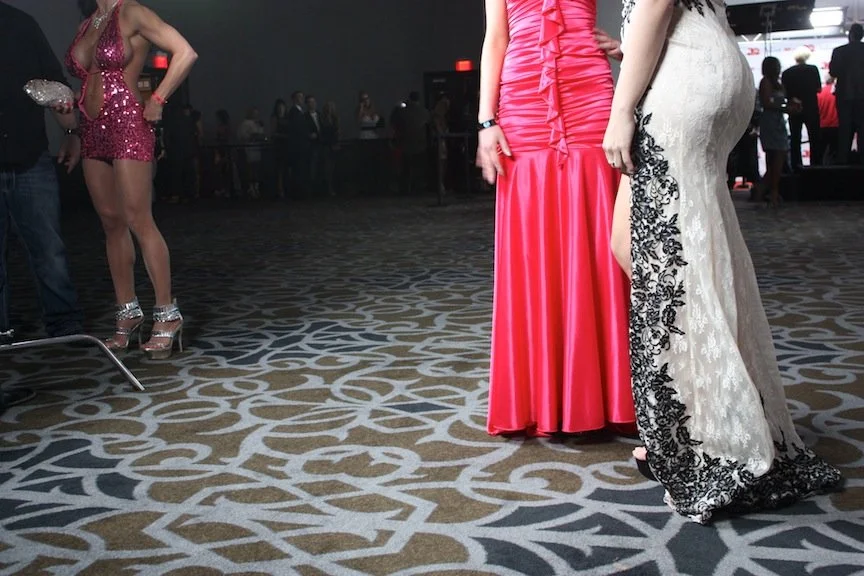
AVN Awards red carpet, Las Vegas, Nev., 2013 | Photo credit: Susannah Breslin
III
For years, the government has been trying to kill the porn business. It’s always something: the Meese Commission, the Obscenity Prosecution Task Force, the Los Angeles Police Department. These days, the enemy is Director of the Office of Management and Budget and key architect of Project 2025 Russell Vought—who mused in a 2024 hidden-camera video: “We’d have a national ban on pornography if we could, right?”—and the weapons of choice are banking discrimination and age verification. This summer, I attended a panel at the Adult Novelty Manufacturers Expo Founders Show at the Los Angeles Marriott Burbank Airport, in Burbank, Calif., where a panel of adult industry experts discussed the challenges of doing business. Interestingly, some adult retailers are seeing an uptick in porn DVD sales to consumers who are choosing to protect their privacy rather than complying with age verification laws. Big Brother is watching, and he doesn’t like porn.
Personally, I am of the opinion that consenting adults should be able to do whatever they want with other consenting adults, regardless of whether or not a camera is recording the action. Admittedly, I am not the average person. Because I have spent a fair amount of time in and around the porn industry, watching people have sex in any number of ways, ranging from the colossally boring to the totally deranged, I am in all likelihood more open-minded than most. Have I seen it all? No. But I have seen nearly all of it. And I have concluded that when it comes to sex, there are people and orifices and bodily fluids, and one can change the number of people and orifices and bodily fluids, but in the end it is all the same. Certainly, was I to sit down in a hotel room with Vought, we would not agree on the matter of pornography.
There is an exception, though. Of all the pornographers I met, I did not like one: Max Hardcore. His real name was Paul Little, and Hardcore was the persona he created to make himself feel less small. His productions were crude muddlings through carnal scenarios in which he depicted himself as a cowboy hat-wearing sexual sadist, his of-age costars dressed like little girls, their hair pulled back in pigtails, discovered sucking on lollipops as they hung out in playgrounds until Hardcore happened upon them. In 2008, he was found guilty on 10 counts of distributing obscene material through the internet and the U.S. mail. “I didn’t realize I’d made a mistake,” he told Judge Susan C. Bucklew at his sentencing, in Tampa, Florida. “My entire life I’ve been trying to do the right thing by people and by the law.” To which Judge Bucklew responded: “Mr. Little, I find this almost incredible.” He was given a 46 month sentence. In 2011, he was released. In 2023, he died, at 66. At the time of his death, he was undergoing chemotherapy for thyroid cancer; a throat infection led to septic shock, pneumonia, and organ failure.
In “My Hard-Core Obsession,” which was published in GQ in 2011, author Shalom Auslander, who was raised in an Orthodox Jewish household in New York, considers his conflicted relationship to Hardcore’s videos, going so far as to visit the actor-producer-director at Federal Correctional Institution, La Tuna, in Anthony, Texas. Incarcerated, stripped of his cowboy hat, and without his signature banana yellow sofa, inmate #44902-112 looks “like he’d be more interested in putting me in a Toyota than a porn film.” Auslander feels bad for watching Hardcore’s movies, for what he fears that says about him. Hardcore attempts to reassure his visitor of the willingness of the female talent who signed up to participate in his stomach-churning movie-making: “‘It’s like boxing. You don’t feel bad for the guy who loses; you don’t wonder why they’re in the ring.’” In his movies, he’s playing a character, Hardcore (or is it Little?) asserts. Auslander’s journey is a sort of guilt-fueled, X-rated version of Are You My Mother?, as he reaches out to others in Hardcore’s orbit—a pornographic actress “known as the female Max Hardcore,” Max’s office manager and “occasional bodyguard,” a “Max Girl”—on his quest to figure out if he should feel bad for viewing, or liking, really, Hardcore’s obscenely hardcore productions. Finally, Auslander decides we are all the same, unless we are pretending otherwise:
Maybe that’s why we take such consolation in meeting other people with their own Max Hardcores, and, paradoxically, why we put our Max Hardcores in prison—because by declaring them obscene, we can tell ourselves that we are not.
Six months after Hardcore was released from prison, I sent him an email. The previous year, I’d heard from Auslander after he’d visited Hardcore at FCI La Tuna. Hardcore had mentioned me during their conversation. (While writing this newsletter, I contacted Auslander, asking if he recalled what Hardcore had said about me. “If I remember correctly, he said you were a cunt,” Auslander responded.) Back then, I’d presumed Hardcore had read a post-verdict 2008 blog post I’d written about him, “To the Max.” In it, I’d posited Hardcore as a Porn Valley pariah; dismissed his body of work (“Mostly, the sex scenes end with his latest costar a mess and Hardcore triumphant”); and concluded, “Because if you’re going to talk about how far we’ve come when it comes to porn, if you’re going to posit Paul ‘Max Hardcore’ Little as the latest victim of the Bush administration, if you’re going to lament one more strike against your First Amendment rights, you should bear witness as to what a porn star drenched in vomit looks like.” Now that he was free, I wanted to know if he would let me interview him. “You always had me wrong, Susannah,” he emailed a few days later. “I don't hate anyone. I just play a bad guy on tv. I deliver to the public what they demand.” In his email, he included two links. One took me to a flattering profile of him from Adult Video News, the adult video industry’s trade publication, “Max Hardcore… Introduces the New Max Hardcore,” which suggested he was a changed man. (His post-release plans? “Hint: They don’t include shooting movies with women pissing, vomiting, fisting or getting fisted.”) The other led me to Auslander’s GQ story. “If you like, read these articles below,” Hardcore wrote, as if attempting to curry favor. “If you still feel the need to chop me up again, then write back.”
This October I attended the filming of a porn movie in a mansion on a dead-end street in an exclusive neighborhood in Beverly Hills. The property had an impressive view of the city from the backyard terrace. I’ve known the director for years, and we spent some time catching up, talking about, among other things, who in the business had died. Hardcore’s name came up. I never liked him, I asserted. But the director did. In fact, they had been close friends. Hardcore was a good guy, a terrific supporter, and really fun at the NFL games they attended together, he told me. Briefly, I considered whether or not I had gotten Hardcore wrong. Maybe he was a man who was merely doing business. Had I confused Max with Paul? Like Auslander, I could have been projecting my own beliefs onto a man who figured out how to make a very comfortable living giving a certain segment of the population what it wanted. What was the harm in that? For his troubles, Hardcore spent two and a half years in prison.
But the director was calling for the scene to begin. The young male actor was dressed as an exterminator. The curvy blonde actress was pretending to be the lady of the house. In a few minutes, the director would shout Action! and the fantasy would start.
In 2018, I wrote a story for The Atlantic, “Porn’s Uncanny Valley,” about how technology had transformed the ways pornography is made. During the course of my research, I paid a visit to Adam Sutra, who at the time was the CEO of CamasutraVR, a company that produced virtual reality pornography. In his downtown Los Angeles loft—a sunny white box with soaring ceilings, concrete floors, and a Pavement poster on one wall—I strapped on an Oculus Rift headset, donned a pair of haptic gloves, and slipped into virtual reality. In a spartan virtual apartment, a virtual porn star modeled after a real porn star was gyrating on a stripper pole. At Sutra’s direction, I picked up a red gun sitting on a counter, pointed it at the woman, and pulled the trigger, showering her in dollar bills. When I reached out and touched her breast, her flesh depressed, but I couldn’t feel anything. A virtual man entered the room. The man and the woman began having sex. The scenery changed to a strip club. The couple reappeared and recommenced having sex. Abruptly, the man’s penis detached from its host and transposed itself onto the woman’s stomach. There was a glitch in the matrix. After I took off the headset, I told Sutra I had experienced a disturbing impulse to punch the woman in the face. “Yeah,” he said, nodding sympathetically. “I hear that a lot.” Perhaps I had perceived the woman—who seemed real and also not—as a threat in porn’s uncanny valley.
On my first porn set visit two decades years prior, I had asked the director if he thought technology posed any kind of threat—material, existential, otherwise—to pornography. The director—a handsome man, who was also a porn star, and whose estranged porn star wife was starring in the very movie he was directing—reacted as if this was the stupidest question he had ever heard in his life. He made a strangled noise. How could technology replace porn? After all, technology was about computers, zeroes and ones, and pixels, and porn was about bodies, flesh, and desire. The idea that technology could compete with human beings fucking was absurd. That said, this was 1997. Technology was all upside. Because of technology, consumers could watch his movies in the privacy of their own homes, instead of having to go to a movie theater. Ergo, technology was good for porn; it was an asset, not a threat. I would hear this sentiment over and over again, for years to come. For a long time, the director was right—the internet was an IV tube pumping porn into people’s minds—until he wasn’t.
I thought about these matters on porn sets. As people sweated and strained, opened their bodies for the cameras and posed for what are referred to as “pretty girl photos” (the photographs taken after the female performer has her hair and makeup done and before the sex that will inevitably mess up her hair and makeup, and which are used to market the movie), and told me their personal and professional histories and about their love lives and families. What struck me was the vast chasm between how those who worked in the porn industry were perceived by the rest of the world and what people in porn were actually like. To outsiders (or, in porn terminology, civilians), a porn star was not quite human, a spectral being on the other side of a screen (a movie theater, a television, a handheld device). But what I experienced was the opposite. These were individuals who had gone to extraordinary lengths and were ostracized for earning an honest living, taking care of their families, and pursuing their dreams. They were actors with Hollywood aspirations, cinephiles with directorial ambitions, parents, caregivers, students, homeowners, and neighbors. Big Tech could try and replace them, but it could never replicate their humanity.
Recently, I opened a new tab in my web browser and typed in the URL for Pornhub. In the search bar, I entered “AI.” A dazzling array of thumbnail images materialized on the page. I surveyed the images, the aesthetics of which ranged from the cartoonish to the could-pass-for-real. I clicked on one labeled hentai. (“ALL CHARACTERS ARE 18+ AND CONSENTED,” the video informed me, in case I was worrying about whether or not the animated characters in the scene I was about to view had consented to what they were about to do.) In a purple-hued room, a male cartoon character and two female cartoon characters had cartoon sex. Had they been human, I might have tried to decipher what they were thinking; since they were not, the answer was: nothing. I clicked on a different video offering a more realistic rendering of its subjects. A nubile AI blonde whose clipped AI dialogue wasn’t synced with the movement of her pouty AI lips recited her lines as if speaking directly to me. The scene was rendered gonzo-style—from the point-of-view of the unseen AI man. Their movements hiccuped, spoiling any suspension of my disbelief. I clicked on another video. An AI Supergirl in an AI urban hellscape agreed to have sex with an AI Doomsday to save humanity. To say what I witnessed next was anatomically impossible would be an understatement. (“You don’t have to do this!” a visibly upset AI Superman wailed from the sidelines.) I closed the tab. It was hard to know what to think, other than AI porn was very uncanny, indeed.
Quite possibly, you work in an industry that has been affected by technology. You used to build cars, but now a robot does it for you. You used to write code, but now Claude does it for you. You used to be a writer, but now ChatGPT does it for you. At first, you told yourself this was progress. Technology was helping you. But you came to find that you were wrong. Technology wasn’t helping you, it was replacing you. You lost your job, or your division was eliminated, or your industry collapsed. Pornography is in a similar position. When porn became freely available online, people no longer felt compelled to pay for it. (To borrow a phrase: First they came for the porn stars and you did not speak out because you were not a porn star.) In today’s world, porn is dealing with the consequences. When I was immersed in Sutra’s virtual reality and the virtual man’s penis went rogue, I wondered if this had happened before. In fact, Sutra said, it had. He referred to this phenomenon as “phantom-limb penis syndrome.” To this day, I’m not entirely sure what he meant. In phantom limb syndrome, the brain does not understand a missing limb is gone; rather, the brain believes the limb is still there. Maybe we are in a similar space with pornography. Technology has wrapped its long arms around everything we touch and see, securing it in a choke hold, as we try to convince ourselves that nothing has changed.
Early on a Saturday morning in June of 2024, I headed east out of Los Angeles on State Route 134 to witness the making of a pornographic film. In the past, a single email or phone call would have gotten me on set. This time, the process was trickier. A multinational pornographic conglomerate wary of negative press was producing the movie. Even though the story I was writing would be published on the website of a business magazine that regularly features billionaires on the cover of its print edition, a protracted negotiation had followed. Nearly two-dozen emails, many assurances, and approximately five weeks later, the publicist had approved my request.
I exited the freeway in Monrovia, a small town nestled in the foothills of the San Gabriel Mountains that has been featured in movies like American Pie, Legally Blonde, and Never Been Kissed. In Old Town, the city’s historic district, parents were pushing their children in strollers along the sidewalks. I passed a toy store, a candy shop, and a 1920s movie theater. In front of the library, a bronze statue of Mark Twain sat on a park bench, holding a copy of Adventures of Huckleberry Finn.
On a side street, an unremarkable building bore the address I had been given. I parked at the corner and walked halfway back up the block. No one was around to greet me, but as luck would have it, one of the steel and glass security front doors was unlocked. From the lobby, I got in the elevator. On the second floor, the doors slid open. Previously, a clinical-stage biopharmaceutical company with a market capitalization of over $1.5 billion had leased the space. On this day, the place was vacant, a maze of unoccupied cubicles, abandoned laboratories, and corner offices in which no one worked.
At the end of a hallway, a crewmember appeared. I was looking for the director, I explained. He led me to the other side of the building. At a desk in a commandeered office, director Ricky Greenwood was studying storyboards on his laptop computer. At 42, the Quebec native had directed over 500 adult movies, among them Lust in Translation, My Mother the Working Girl, and HELP! There’s a Ghost in My Vagina. He stood up to greet me, and we shook hands. Tall, husky, and heavily tattooed, he had a full ginger beard streaked with grey. In his trucker hat, Black Pumas T-shirt, black shorts, and yellow Nike Air Force 1 high-top sneakers, he could have been mistaken for a music video director.
Since everyone was busy getting ready to film the next scene, I wandered around. In a break room, a minimalist craft services spread was laid out on the counter: sodas and bottled waters, cookies and chips, a platter of supermarket sandwiches. In a big office, Mick Blue, a 47-year old Austrian actor with grombre hair and arctic blue eyes who has acted in over 1,000 adult movies, was getting ready. In the adult industry, Blue is an icon. In 2015, he won Male Performer of the Year at the AVN Awards; in 2017, he was inducted into the AVN Hall of Fame. As the woman in charge of wardrobe helped him into a white lab coat—“Dr. John Harding GENETICIST,” his name tag read—I asked him about the demands of his job.
“As performers, we are like athletes,” he said in a thick accent.
At that moment, Cherie DeVille, a forty-something brunette who bills herself as “the internet’s stepmom,” entered the room. In 2017, the former physical therapist ran for president of the United States as an independent; her vice-presidential running mate was the rapper Coolio, and her campaign slogan was “Make America Fucking Awesome Again.” For this scene, she would be playing a biologist.
Shortly thereafter, we convened in a meeting room. Two women in shirts emblazoned with the name of the production company and Greenwood sat on one side of the table; DeVille and Blue sat on the other. One of the women began recording a video of the proceedings on her mobile phone. The purpose of this session was to go over the three-page Pre-Shoot Discussion & Boundary Checklist, as required by the production company. The mandatory review would ensure everyone knew what sex acts would be performed in the upcoming scene with the consent of the talent.
The checklist’s first column listed 30 “Sex Acts” in alphabetical order. The second column was where the performers wrote a Yes or a No. The third column was for Specifications. The acts ranged from the relatively mundane—Biting, Hair Pulling, Kissing—to the decidedly more extreme—Fisting, Pegging, Slapping. In several instances, a Yes prompted the performer to provide further details. In the cases of Slapping, Spanking, and Spitting, “if yes, specify where on the body.” Vaginal Penetration wanted to know if with a “penis, toy, object, finger.” Name-calling queried “specify what names.” For the average person, sex was spontaneous. In the manufactured erotics of porn in the 2020s, little was left to chance.
As the camera recorded, the performers read their checklists out loud. Blue vetoed penis biting. DeVille shared: “You can do four fingers but not the whole shebang.” Blue advised: “I’m not into name calling.” They were both okay with nipple pinching and rim jobs. DeVille observed: “I’m just not a squirter.” When the actors were finished, they signed each other’s release forms. “Get ready for sex, guys,” the director said. DeVille went to prep. Greenwood told me the checklist was so the performers “feel more safe, they feel more heard, they feel more respected.”
This ritual was a far cry from what I had seen on the set of Flashpoint in 1997. That evening, I had observed the filming of the second sex scene of the day. This one starred a famous blonde porn star and a male performer with a reputation for aggressive performances. The fantasy sequence on the second-floor of the brick warehouse featured rows of 10-foot flames that shot up behind the actors. As the actor walked into the middle of the room and the actress bent herself over a barrel, she looked over her shoulder and said: “Take it easy on me, okay?”
In a corridor, DeVille and Blue, both in white lab coats, waited near a gurney. The lighting guy tweaked the lighting. Three cameramen fiddled with their cameras. In a half-dark adjacent room, Greenwood stroked his beard as he surveyed the live feeds on a trio of monitors.
“And, action,” Greenwood called. The room went quiet. The cameramen moved in and out, following the actors’ lead. Generally, Greenwood takes a hands-off approach to filming sex scenes: “If you direct them, it become like a job for them, and it become like a fake scene.”
As DeVille and Blue gamely worked their way through the choreography of sex-on-camera, the action from three different angles played on the monitors. The authenticity was evident in their bodies: the glistening skin, the straining muscles, the open mouths. Later, I would watch the scene at home on my desktop computer. On the screen, it seemed even more real, the camera fetishizing its subjects. Perhaps this is why pornographic video-sharing and streaming websites are among the most visited in the world.
In an age of fakery, hardcore is inarguably honest.
Whenever I talked to Evan over the years before he took his life, he would tell me that he wanted to write a book about his time in the porn business. It’s where I learned to be a journalist, he would say, sounding nostalgic. I don’t know if he was writing that book; or if he was, if he finished it; or if he finished it, if it would ever be published. Before my father died, he had begun working on a biography of John Coltrane. When a writer dies, those left behind experience a twofold grief: the loss of the writer and the loss of the stories that writer will never tell.
As someone who had struggled with suicidal ideation myself, I ruminated over Evan’s suicide. What was going through his head that led him to make that final decision? I reread his LA Weekly story about his stint at Hustler. It was relentlessly grim, ruthlessly self-indicting, and a twisted love letter to a place that no longer exists. “I finally left the porn business not because I had any sort of moral awakening, but because I found a better job,” he writes. “Today, whenever I see a new issue of Hustler or Barely Legal at the liquor store, I always flip it open, and forget everything I know. The illusions are real.” I’d always puzzled over the last line: The illusions are real. Was he saying the same thing I was when I wrote: “In Porn Valley, reality and fantasy are one and the same”? The only person who could tell me was gone.
Acting on journalistic habit, I ordered a copy of the Medical Examiner’s report which explained more about what happened. As I paged through the document, I kept returning to the body diagram. I wasn’t sure if I was poring over Evan’s autopsy report or standing over my father’s dead body at which I had refused to look three decades earlier. What was my father thinking when his heart exploded? I would never know. Both Evan and my father would remain a mystery to me, a puzzle that refused to be solved.
As for what I learned writing about the adult movie business for nearly 30 years, the answer is a lot—about human nature, about sex work, about naked capitalism.
For example:
Female porn stars are tougher than male porn stars.
Male porn stars have a hard job but not for the reasons you’d think.
Porn directors and porn producers are pornographers by profession and businesspeople by nature.
People who try to ban porn are the people most drawn to it.
Porn is a dream factory—not unlike, say, Disney.
The truest thing anyone ever said to me about porn was related to me by a producer who the Department of Justice had charged with “six counts of using an interstate common carrier to transport DVDs that are obscene” and who told me: If people didn’t want it, it wouldn’t be made.
People like the woman who commented on my work, “I still think women should not perptuate [sic] the sexual deviancies of men in order to survive, no matter how good the money,” have internalized misogyny.
If someone says they don’t like porn or think porn is bad, that says more about them than it does about porn.
As for how the porn business changed, the answer is to a degree that is incredible and irreducible.
For example:
When I arrived on the scene, big production companies dominated, smaller production companies were cropping up across the Valley like weeds, and you could sense the fervor of the competition.
The top stars were untouchable and inaccessible.
The top directors shot features.
The top producers made a killing (financially speaking).
The annual AVN Adult Entertainment Expo and AVN Awards were massive affairs.
Then technology changed everything.
Most of the major production companies were acquired by companies with names you don’t know that are based in places outside the U.S. and run by CEOs more interested in profits than porn.
Movies have been replaced by content.
Paying for porn has been replaced by free porn.
Porn stars have been outnumbered by adult content creators.
Online content paid subscription services like OnlyFans have cut out the middleman to take explicit content directly to consumers.
“Porn is boring now,” a director I’ve known a long time lamented to me a while ago on the set of a movie he was making for somebody else.
“All these rules,” the lighting guy concurred, nodding sadly. “Back then, there were no rules.”
As for how writing about porn changed me, the answer is less obvious.
For example:
On the one hand, it would be an understatement to say that exposing myself to the extreme nature of the porn business in its early, halcyon days—especially but not limited to what I witnessed on the set of The World’s Biggest Gang Bang III—instilled in me a more jaundiced view of human nature.
On the other hand, I spent so much time studying human sexuality vis-à-vis pornography I can surmise what a person is into sexually just by looking at them (I refer to this gift as “sexdar,” trotting it out as a party trick after I’ve had a few drinks).
Fundamentally, I am a free speech absolutist, because if you allow certain types of speech and forbid other types of speech you cannot say you are a unilateral supporter of freedom of speech.
Ultimately, I don’t think writing about porn made me a better or a worse person, although I do think it made me who I am.
The first time I stepped on a porn set, I fell in love with that world, and, as is the case with any enduring, meaningful marriage, sometimes we are in love, and sometimes we are not, but we continue, regardless.
Fifteen years ago, I learned a malignant tumor had secreted itself in the inner-curve of my right breast. At the time, I was living in the Midwest and writing about porn only intermittently, in part due to the fact that I was married to a man who in my opinion did not enjoy having a wife who wrote about pornography. The suburban hospital where I underwent treatment—multiple surgeries, chemotherapy, an expensive gene-targeting drug for my rare type of breast cancer, radiation, etc.—over an 18-month period took a holistic approach to healthcare, including acupuncture; a nice, terminally ill woman who led me through guided meditation as an IV dumped a toxic cocktail of drugs into my system in a private room in the cancer ward; and a youngish, bearded therapist I referred to when not in his presence as “my cancer shrink.” In one such therapeutic session, I informed the cancer shrink that if I didn’t die, I would return to Porn Valley and write a book about it. The cancer shrink’s face was placid and unreadable in response (if no response could be described as a response); I had no idea what he thought of my proclamation (one can imagine it might have stood out from the other proclamations other cancer patients had made to him over the years). Either way, the tumor was extracted, the drugs worked, and I was pronounced cancer-free. It would be years before I would get divorced and move back to Los Angeles to start writing that book—after all, every hero must first refuse the call—but eventually I did just that.
In October, I was on the set of a porn movie being filmed in Las Vegas. Nowadays, the adult movie business has spread out across the country, with satellite hubs in Sin City and Miami. In a blacked-out room, there were three people: the actress, the director who was also the cameraman, and me. The director had mounted a ring light to the video camera, the effect of which was to illuminate the actress in a spotlight: her fiery red hair, her nude body, her brilliant blue, cat eyes. At one point, she was down on the floor, writhing around in a paroxysm of pleasure, as the camera hovered above her, studying her like a research scientist studies a lab rat. It’s hard to describe what it was like to be there, but I wish you could have seen it. On a porn set, should you chance to look beyond the obvious, there is an extraordinary kind of beauty.
In Francis Ford Coppola’s Apocalypse Now Redux, Captain Willard and his crew come upon a rubber plantation owned by a French family that refuses to leave Cambodia despite the war. That evening, Willard finds himself in a bedroom with a beautiful French widow. As the lovers lay in bed smoking opium, she recounts the story of her late husband, “my lost soldier.” In Willard, she recognizes the same existential crisis: Is he an animal or a god? “But you are both,” she tells him. “All that matters is that you are alive. You are alive, Captain. That’s the truth.”
This story was originally published as a 10-part series on The Reverse Cowgirl.